|
TECHNICAL BULLETIN NO.
TB-FL0108
CO emissions are not only a health and safety
issue, measuring them can be a tool for controlling fuel costs.
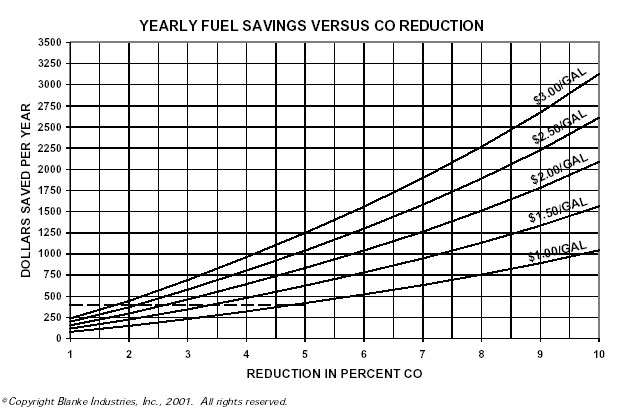
Any CO above 0.5% at idle, cruise (governed throttle)
and full load indicates wasted fuel. At 5% CO, a forklift can be
wasting between $415 to $1,250 of fuel per year. Ten forklifts
averaging 5% CO, will waste $4,150 to $12,500 per year, a
significant amount. Traditionally, over half the forklifts tested
are above 5% CO and occasionally they are above 10%. A forklift
wastes 3% to 5% of its fuel for each 1% CO above this 0.5% CO
target.
To get a good CO profile of the forklift, testing
should be done at three different operating conditions. The first
test is the CO at idle. The second test is the CO at cruise.
And, the third CO test is done at full load. The
averaged results of these three tests will give a reasonably
accurate CO and fuel usage profile of a forklift.
After these are measured, the next step is to
determine the average of these three CO readings. For example, if...
• Idle CO = 4.8%,
• Cruise CO = 5.2% and
• Loaded CO = 6.5%, then
• Average CO = 5.5%
After a tune-up and carburetor adjustment, the
average CO readings should be about 0.5% CO. In this example, the
difference between the average CO readings before and after a
tune-up, 5.5% minus 0.5%, is 5.0%, equaling a fuel savings of about
20%. The fuel dollars saved per year, for one forklift running on
one shift for various fuel costs are shown in the graph below. Using
this example, a forklift with
CO lowered from 5.5% CO to 0.5% CO and fuel costing between $1/gal
to $3/gal will save between $415 to $1,250 per year. Both CO
emissions and fuel costs are reduced.
Printable (PDF
Version)
|